

How to Read a Fine Line Tattoo Portfolio Before You Book
A fine line tattoo can look crisp the minute the artist finishes it. That photo answers a useful question: can the artist place the design cleanly? It does not answer how the lines settled after healing, or whether the design still reads at the size you want. If you are comparing fine line tattoo shops around Mesa, look at the portfolio as a set of decisions, not a highlight reel.
Tagz Tattoo's fine line gallery shows work across scripts, florals and illustrative pieces. Its artists work in other styles too, so ask which artist is currently taking fine line bookings. The roster changes; the right comparison is between the artist who would do your piece and the type of piece you want.
Ask to see the design at a real size
Phone screens make every tattoo the same size. An enlarged image of a tiny design can hide the fact that its lettering or small negative spaces will be crowded on skin. Tell the artist your proposed placement and approximate dimensions. If you have a reference image, show it alongside something that gives scale: your hand, a ruler, or the part of the body where it will go.
Look at the space between the lines as closely as the lines themselves. In a script tattoo, can you distinguish the letters at arm's length? In a small floral piece, do the petals separate cleanly? An artist may suggest opening the spacing or enlarging the design. That edit can preserve the idea better than copying a reference at a size where its detail disappears.
Compare the photo with the placement you have in mind
| In the portfolio | Ask the artist |
|---|---|
| A forearm design | Would the same detail work on a wrist or finger? |
| Fine script | What letter spacing would keep this phrase legible? |
| A floral or illustrative piece | Which details could be simplified at my target size? |
| A fresh photo | Do you have healed examples in this style? |
Placement affects both how the design wraps around the body and how much friction or sun the area sees. A flat reference image is only the starting point. Tagz's fine line page specifically warns that hands and fingers are higher-friction spots; the artist should explain what that means for your idea before you settle on a placement.
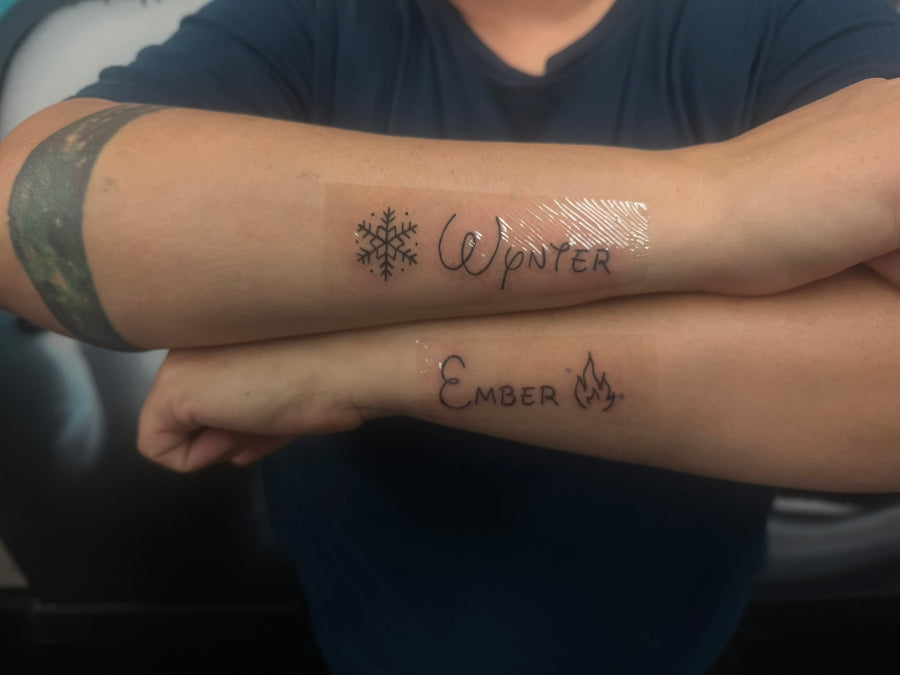
Ask about healed examples without treating them as guarantees
Healed photos are more informative than day-one photos because they show the line after the skin has settled. They are still examples from different people, placements and routines. Ask what changed between the fresh and healed views, and what the artist would do differently for your skin or location. A useful answer should sound specific to the piece in front of you.
Do not judge an artist by whether every image looks identical. A delicate floral outline, a script name and a black-and-grey illustration have different visual goals. Look for work close to the style and scale you want. If the portfolio lacks that type of work, ask to see more relevant examples or meet a different artist.
Bring a small, useful reference set
Two or three examples are enough to begin: one for the subject, one for the line weight and one for the placement. Say what you like in each image. That gives the artist room to make an original design that works on your body. Tagz offers free consultations at its Mesa studio, so you can discuss the references before you commit to a design or date.
The best portfolio question is simple: “Can you show me work close to what I want, at the size and placement I am considering?” A fine line tattoo artist should be able to show relevant work, explain the limits and help you choose a design that still looks like your idea after the photo moment has passed.
